My artistic practice explores the intersections of ecology, care, memory, and collective coexistence through painting. Rooted in field research and lived experience, my recent body of work emerges from sustained engagement with the Hargila Bahini of Assam, a women-led grassroots movement committed to the conservation of the endangered Greater Adjutant Stork, locally known as the Hargila. Encountering the women’s everyday acts of protection and stewardship transformed my understanding of conservation, revealing it not merely as an environmental imperative, but as a deeply cultural, relational, and ethical practice sustained through networks of care.
In 2024, I completed my PhD thesis, Ecosophy in Praxis: Art Practice as an Interdisciplinary Approach to Social Engagement and Ecological Sustainability. Following a period of academic engagement and maternity leave, I returned to the studio with a renewed commitment to investigating community-based conservation, ecological interdependence, and the often-unacknowledged labour of women in sustaining fragile environmental futures. Beginning with intimate works on rice paper, this inquiry has gradually expanded into larger-scale paintings that negotiate both personal reflection and collective ecological narratives.
My visual language draws significantly from Japanese painting traditions, particularly their attentiveness to atmosphere, silence, temporality, and the porous relationship between human and non-human worlds. Indian and Persian miniature traditions also inform my practice through their layered spatial constructions, narrative density, and symbolic modes of storytelling. These influences converge within a contemporary painterly framework that seeks to hold together fragility, memory, and coexistence.
Within these works, architecture, vegetation, birds, and human presence are interwoven into imagined ecological habitats that resist rigid separations between nature and culture. Recurring motifs such as banana plants and bamboo structures function as metaphors for the rhizome, embodying interconnectedness, resilience, regeneration, and collective forms of knowledge-making. Their repeated presence reflects the networks of reciprocity and cooperation I encountered through my engagement with the Hargila Bahini. The woven textures and layered surfaces within the paintings further evoke the handloom traditions practiced by many of the women associated with the movement, linking acts of weaving, nurturing, and ecological preservation.
Rather than representing conservation as an isolated event or environmental spectacle, my paintings attempt to foreground the invisible relationships that make coexistence possible. Through these works, I seek to create contemplative spaces where ecology can be understood as an ethics of care, and where the lives of women, birds, plants, water, and habitats are recognised as fundamentally entangled and mutually sustaining.

Abhilasha Pandey
Title: Hargila Stories
Medium: watercolor and gouache, ink on rice paper pasted on ply board
Size: 11.5 x 15.6 inches each
Year: 2026

Abhilasha Pandey
Title: Common Grounds (Set of 3 drawings)
Medium: Ink, watercolor and gouache on rice paper pasted on plyboard
Size: 11.5 x 15.6 inches each
Year: 2026

Abhilasha Pandey
Title: When the Hargila Returns
Medium: watercolor and gouache on rice paper pasted on ply board
Size: 11.8 x 15.8 inches each
Year: 2026
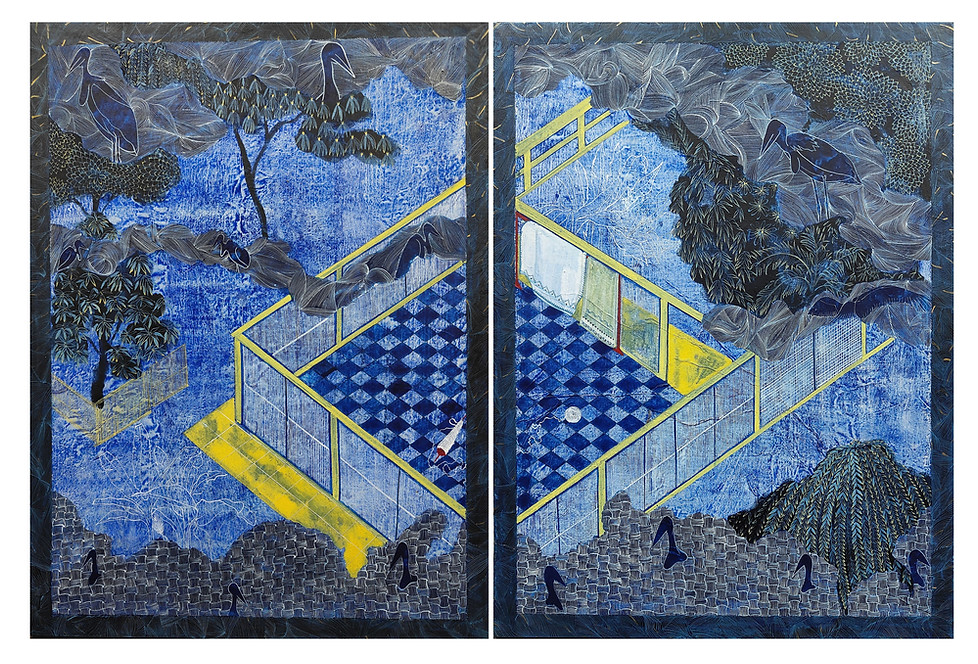
Abhilasha Pandey
Title: Woven Habitat: When the Hargila Returns
Medium: watercolor and gouache on rice paper pasted on ply board
Size: 11.8 x 15.8 inches each
Year: 2026